PUBLISHER: Mordor Intelligence | PRODUCT CODE: 2120305

PUBLISHER: Mordor Intelligence | PRODUCT CODE: 2120305
High-End Copper Foil - Market Share Analysis, Industry Trends & Statistics, Growth Forecasts (2026 - 2031)
According to Mordor Intelligence, the high-End copper foil market size is estimated at USD 1.16 billion in 2026, and is expected to reach USD 1.58 billion by 2031, at a CAGR of 6.38% during the forecast period (2026-2031).
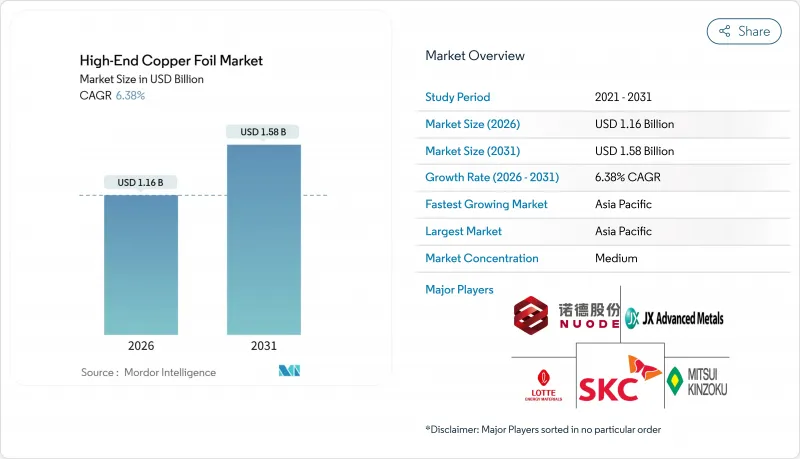
This report is Segmented by Product Type (Rolled Copper Foil and Electrodeposited Copper Foil), Application (Circuit Boards, Batteries, Solar and Alternative Energy, Appliances, Medical, and Others), and Geography (Asia-Pacific, North America, Europe, South America, and Middle East and Africa). The Market Forecasts are Provided in Terms of Value (USD).
Global High-End Copper Foil Market Trends and Insights
EV Battery Demand for Ultra-Thin High-Purity Foils
Every 2 µm reduction in foil thickness lifts gravimetric energy density by 5-6%, spurring OEMs to adopt 6 µm and 4 µm anode collectors. China shipped 1,334 GWh of lithium batteries in 2025 and is on track for 1,622 GWh in 2026, but July 2026 purity mandates will push marginal mills out of the high-end copper foil market. Western gigafactories demand 99.99% purity and sub-1% elongation variance, tilting awards toward Japanese and Korean suppliers. The International Energy Agency warns of a 30% primary-copper shortfall by 2035, intensifying the importance of thin-foil yield management. Premium electrodeposited grades command USD 22-28 per kg versus USD 15-18 for standard 8 µm foils, rewarding mills that master sub-6 µm deposition.
5G / HPC Push for High-Frequency PCBs
Hyperscale data centers upgrading to 800G and 1.6T Ethernet require dielectric constants below 3.5, forcing laminate makers to use ultra-low-profile rolled foils with surface roughness under 0.4 µm. Rogers Corporation's RO4000 laminate lead times lengthened from 16 to 26 weeks in 2025 because copper-foil supply was constrained. AI accelerator boards lose competitiveness when insertion loss exceeds 1 dB per inch, encouraging buyers to secure foil allocations a year in advance. IPC-6018D design rules now carve out rolled foil for mmWave boards, lifting spot premiums 15-20% above contracts. Integrated suppliers that own both rolling mills and laminate lines capture the value.
Copper Price Volatility and Margin Squeeze
London Metal Exchange spot rose to USD 11,200/t in October 2025, with Q2 2026 forecasts near USD 12,500/t, slashing foil-maker EBITDA by 2-3 percentage points because pass-through clauses lag 60-90 days. Smaller South Asian mills lacking hedge programs posted negative margins in Q3 2025 when premiums widened to USD 280/t. The IEA foresees a structural 30% copper supply deficit by 2035, preserving volatility. Producers are locking multi-year concentrate offtakes and investing in scrap recycling, but benefits accrue only after 18-36 months.
Other drivers and restraints analyzed in the detailed report include:
- Regional Gigafactory Localisation Wave
- Closed-Loop Battery-Grade Foil Recycling Initiatives
- Chinese Over-Capacity-Led Price Wars in Li-Battery Foil
For complete list of drivers and restraints, kindly check the Table Of Contents.
Segment Analysis
Rolled copper accounted for 59.67% of 2025 value, supported by root-mean-square roughness near 0.35 µm and unrivaled mechanical strength that mitigates skin-effect losses on 30-300 GHz boards. Electrodeposited foil is projected to grow at 8.44% CAGR, driven by battery makers migrating toward 6 µm and 4 µm gauges that electrodeposition can deliver uniformly across 1,350 mm widths. Capital intensity runs above USD 100 million per multi-stage rolling mill, fostering an oligopoly among Japanese and European producers who can charge USD 28-35 / kg for ultra-smooth variants. Conversely, Chinese electrodeposition capacity surged to 600,000 tpa by 2024, sparking price wars in standard 8 µm grades.
Electrodeposited processes allow higher throughput and lower micro-crack risk below 5 µm thickness, an edge as the high-end copper foil market pivots to energy-dense cells. Meanwhile, 5G and AI boards drive pre-booking of rolled-foil allocations 12 months ahead, creating dual supply chains. Integrated rolled-foil mills are forward-integrating into laminates, while electrodeposited specialists co-locate near gigafactories to offer just-in-time delivery. These divergent models illustrate how the high-end copper foil market continues to bifurcate.
Complete Report Scope:
- By Product Type
- Rolled Copper Foil
- Electrodeposited (ED) Copper Foil
- By Application
- Circuit Boards
- Batteries
- Solar and Alternative Energy
- Appliances
- Medical
- Others
- By Geography
- Asia-Pacific
- China
- Japan
- South Korea
- India
- ASEAN Countries
- Rest of Asia-Pacific
- North America
- United States
- Canada
- Mexico
- Europe
- Germany
- United Kingdom
- France
- Italy
- Spain
- NORDIC Countries
- Rest of Europe
- South America
- Brazil
- Argentina
- Rest of South America
- Middle-East and Africa
- Saudi Arabia
- South Africa
- Rest of Middle East and Africa
- Asia-Pacific
Geography Analysis
Asia-Pacific generated 69.60% of 2025 revenue and is forecast at a 6.72% CAGR through 2031, bolstered by China's large production share and South Korea's sub-6 µm expertise. China's July 2026 GB standard is forcing technical upgrades or exits, squeezing commodity producers but supporting premium price realization. South Korea's SKC, Solus Advanced Materials, and LS MTRON are scaling capacity in Poland and Malaysia to serve EU and ASEAN gigafactories, while Japanese players prioritize quality in high-purity and rolled niches.
North America and Europe are pivoting toward localization. The high-end copper foil market size for North America is set to expand as the Inflation Reduction Act primes gigafactory investment. Yet only 18,000 tpa of regional electrodeposited capacity existed in 2025, necessitating imports at 12-15% cost premiums until greenfield lines in Mexico and Hungary come online. Europe's Battery Regulation layers recycled-content mandates that favor co-located recycling, attracting investments from Redwood Materials and Umicore.
South America, the Middle East, and Africa remain import-dependent. Brazil buys about 10,000 t of copper foil yearly for consumer electronics, while Saudi Arabia's Vision 2030 stimulates data-center builds that demand high-frequency laminates. South Africa's mining base offers concentrates, but the region lacks foil fabrication, hinting at future semi-finished export models if Southern African battery clusters emerge.
- Chang Chun Petrochemical Co. Ltd
- Co-Tech Development Corporation
- Doosan Corporation Electro-Materials.
- FUKUDA METAL FOIL & POWDER CO., LTD.
- Furukawa Electric Co., Ltd
- JX Advanced Metals Corporation
- Kingboard Holdings
- Londian Wason (Shenzhen) Holdings Group Co., Ltd.
- Lotte Energy Materials
- LS MTRON LTD.
- Mitsui Kinzoku Co., Ltd.
- NAN YA PLASTICS CORPORATION
- Nuode New Materials Co Ltd
- SKC
- Solus Advanced Materials
- Sumitomo Metal Mining Co., Ltd.
- Targray Technology International
- UACJ Foil Corporation
- Wieland
Additional Benefits:
- The market estimate (ME) sheet in Excel format
- 3 months of analyst support
TABLE OF CONTENTS
1 Introduction
- 1.1 Study Assumptions and Market Definition
- 1.2 Scope of the Study
2 Research Methodology
3 Executive Summary
4 Market Landscape
- 4.1 Market Overview
- 4.2 Market Drivers
- 4.2.1 EV Battery Demand for Ultra-Thin High-Purity Foils
- 4.2.2 5G / HPC Push for High-Frequency PCBs
- 4.2.3 Regional Gigafactory Localisation Wave (North America and European Union)
- 4.2.4 Closed-Loop Battery-Grade Foil Recycling Initiatives
- 4.2.5 Tight Supply of HF PCB Substrates Drives Premium Foil Demand
- 4.3 Market Restraints
- 4.3.1 Copper Price Volatility and Margin Squeeze
- 4.3.2 Chinese Over-Capacity-Led Price Wars in Li-Battery Foil
- 4.3.3 Sodium-Ion Shift (Al Current Collectors) Cannibalises Copper
- 4.4 Value Chain Analysis
- 4.5 Porter's Five Forces
- 4.5.1 Bargaining Power of Suppliers
- 4.5.2 Bargaining Power of Consumers
- 4.5.3 Threat of New Entrants
- 4.5.4 Threat of Substitutes
- 4.5.5 Degree of Competition
5 Market Size and Growth Forecasts(Value)
- 5.1 By Product Type
- 5.1.1 Rolled Copper Foil
- 5.1.2 Electrodeposited (ED) Copper Foil
- 5.2 By Application
- 5.2.1 Circuit Boards
- 5.2.2 Batteries
- 5.2.3 Solar and Alternative Energy
- 5.2.4 Appliances
- 5.2.5 Medical
- 5.2.6 Others
- 5.3 By Geography
- 5.3.1 Asia-Pacific
- 5.3.1.1 China
- 5.3.1.2 Japan
- 5.3.1.3 South Korea
- 5.3.1.4 India
- 5.3.1.5 ASEAN Countries
- 5.3.1.6 Rest of Asia-Pacific
- 5.3.2 North America
- 5.3.2.1 United States
- 5.3.2.2 Canada
- 5.3.2.3 Mexico
- 5.3.3 Europe
- 5.3.3.1 Germany
- 5.3.3.2 United Kingdom
- 5.3.3.3 France
- 5.3.3.4 Italy
- 5.3.3.5 Spain
- 5.3.3.6 NORDIC Countries
- 5.3.3.7 Rest of Europe
- 5.3.4 South America
- 5.3.4.1 Brazil
- 5.3.4.2 Argentina
- 5.3.4.3 Rest of South America
- 5.3.5 Middle-East and Africa
- 5.3.5.1 Saudi Arabia
- 5.3.5.2 South Africa
- 5.3.5.3 Rest of Middle East and Africa
- 5.3.1 Asia-Pacific
6 Competitive Landscape
- 6.1 Market Concentration
- 6.2 Strategic Moves
- 6.3 Market Share/Ranking Analysis
- 6.4 Company Profiles (includes Global level Overview, Market level overview, Core Segments, Financials as available, Strategic Information, Market Rank/Share, Products and Services, Recent Developments)
- 6.4.1 Chang Chun Petrochemical Co. Ltd
- 6.4.2 Co-Tech Development Corporation
- 6.4.3 Doosan Corporation Electro-Materials.
- 6.4.4 FUKUDA METAL FOIL & POWDER CO., LTD.
- 6.4.5 Furukawa Electric Co., Ltd
- 6.4.6 JX Advanced Metals Corporation
- 6.4.7 Kingboard Holdings
- 6.4.8 Londian Wason (Shenzhen) Holdings Group Co., Ltd.
- 6.4.9 Lotte Energy Materials
- 6.4.10 LS MTRON LTD.
- 6.4.11 Mitsui Kinzoku Co., Ltd.
- 6.4.12 NAN YA PLASTICS CORPORATION
- 6.4.13 Nuode New Materials Co Ltd
- 6.4.14 SKC
- 6.4.15 Solus Advanced Materials
- 6.4.16 Sumitomo Metal Mining Co., Ltd.
- 6.4.17 Targray Technology International
- 6.4.18 UACJ Foil Corporation
- 6.4.19 Wieland
7 Market Opportunities and Future Outlook
- 7.1 White-space and Unmet-need Assessment

