PUBLISHER: Mordor Intelligence | PRODUCT CODE: 2124033

PUBLISHER: Mordor Intelligence | PRODUCT CODE: 2124033
Polychlorotrifluoroethylene - Market Share Analysis, Industry Trends & Statistics, Growth Forecasts (2025 - 2031)
According to Mordor Intelligence, the polychlorotrifluoroethylene market size was valued at 7.14 Million tons in 2025 and is estimated to grow from 7.31 Million tons in 2026 to reach 8.21 Million tons by 2031, at a CAGR of 2.36% during the forecast period (2026-2031).
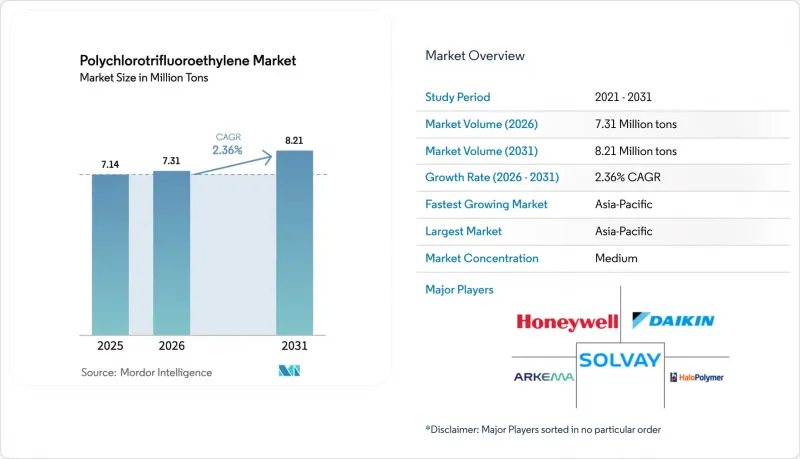
This report is Segmented by Application (Films and Sheets, Wires and Cables, Coatings, and Other Applications), End-User Industry (Pharmaceutical, Aerospace, Electrical and Electronics, and Other End-User Industries), and Geography (North America, South America, Europe, Asia-Pacific, and Middle-East and Africa). The Market Forecasts are Provided in Terms of Volume (Tons).
Global Polychlorotrifluoroethylene Market Trends and Insights
Pharma Blister-Pack Demand Surge
Cold-form blister lines are switching from aluminum-only laminates to PCTFE-aluminum structures because PCTFE delivers a water-vapor transmission rate below 0.05 g/m2/day, which safeguards biologics and high-potency generics during ambient transport. Aclar and PERLALUX films dominate premium grades, while Chinese converters underbid on generic packs to win share in cost-sensitive segments. Regulatory approvals from the FDA and the European Medicines Agency validate PCTFE for biosimilars and gene therapies, opening higher-value orders for converters that can supply pharmaceutical-grade traceability. Investment in high-speed thermoforming equipment narrows historical productivity gaps versus PVC, so converters no longer have to trade barrier performance for line speed. The result is an enduring pull on the Polychlorotrifluoroethylene market as global prescription volumes rise and cold-chain stress eases.
Aerospace Cryogenic Sealing Growth
Rocket engines, propellant transfer systems, and hydrogen refueling hardware require seals that keep elasticity at -253 °C. PCTFE stays ductile where PTFE turns brittle, thus rocket-grade valves, O-rings, and flange gaskets default to PCTFE across NASA Artemis and Ariane 6 platforms. Commercial launch providers add similar specifications, locking in multi-year tonnage with rigorous qualification barriers that protect incumbents. As spaceflight and green-hydrogen aviation scale, ground support equipment orders add continuous demand for high-purity machined shapes. Aerospace therefore preserves a stable core within the Polychlorotrifluoroethylene market even when macrocycles shift.
Substitute Fluoropolymers (PTFE, PVDF)
PTFE and PVDF deliver comparable chemical resistance at lower resin cost and simpler processing, so converters often down-spec assemblies where barrier or cryogenic extremes are not mission-critical. PVDF's weldability and availability from new Kentucky capacity heighten price pressure on commodity PCTFE parts. As compounders tailor filled PTFE grades with improved wear resistance, overlap widens, forcing PCTFE suppliers to differentiate via ultra-high purity and custom formulations. This cost-performance squeeze tempers upside for the Polychlorotrifluoroethylene market until high-barrier or cryogenic requirements prevail.
Other drivers and restraints analyzed in the detailed report include:
- Electronics Low-k Insulation Uptake
- Hydrogen Fuel-Cell Sealing Adoption
- PFAS Regulatory Overhang
For complete list of drivers and restraints, kindly check the Table Of Contents.
Segment Analysis
Films and Sheets contributed 46.64% of 2025 volume, representing the largest slice of the Polychlorotrifluoroethylene market share, and will register a 2.60% CAGR through 2031. This dominance stems from cold-form blister demand and helium-barrier membranes that protect sensitive gases during storage. Pharmaceutical converters favor PCTFE because it halves moisture ingress compared with PVC-PVdC laminates, while gas processors value helium selectivity above 3,700 for low-concentration streams.
Wire and Cable holds a considerable share, powered by 5G rollouts and electric-vehicle charging systems that need low-loss RF performance. PCTFE's dielectric constant near 2.4 and thermal stability to 200 °C enable thin-wall jacketing in high-frequency cables, though PVDF prices spur substitution where dielectric margins allow. Coatings remain niche due to limited solvent compatibility and adhesion hurdles, yet specialty reactors and valve bodies still specify PCTFE linings when permeation control overrides cost concerns. Advancements in melt-extrusion control aim to deliver sub-25 micron film gauges for flexible circuits, a move that could secure additional share if converters achieve uniformity without pinholes.
Films benefit from regulatory acceptance and rising biologics pipelines, creating volume resilience even during macro down-cycles. Wire and Cable growth links to data-center expansion and automotive electrification, but its trajectory is more cyclical and sensitive to infrastructure budgets. Coatings face sustained substitution risk from PVDF and FEP coatings that offer easier spray or dip processes. As converters leverage continuous-cast and blown-film technology upgrades, throughput gains keep unit costs stable, supporting segment profitability despite moderate resin inflation. Cumulatively, these trends fortify application-level diversity and insulate the Polychlorotrifluoroethylene market from single-sector shocks.
Complete Report Scope:
- By Application
- Films and Sheets
- Wires and Cables
- Coatings
- Other Applications
- By End-user Industry
- Pharmaceutical
- Aerospace
- Electrical and Electronics
- Other End-user Industries
- By Geography
- North America
- United States
- Canada
- Mexico
- South America
- Brazil
- Argentina
- Rest of South America
- Europe
- Germany
- United Kingdom
- France
- Italy
- Spain
- Turkey
- Russia
- NORDIC Countries
- Rest of Europe
- Asia-Pacific
- China
- India
- Japan
- South Korea
- ASEAN Countries
- Rest of Asia-Pacific
- Middle-East and Africa
- Saudi Arabia
- South Africa
- Rest of Middle-East and Africa
- North America
Geography Analysis
Asia-Pacific dominates the Polychlorotrifluoroethylene market with 44.00% of 2025 volume and a 2.82% CAGR outlook through 2031. China anchors demand owing to semiconductor equipment localization and increased PCTFE uptake in domestic blister-pack lines. Regional producers gain share as 3M exits PFAS manufacturing, but quality-control requirements keep Western incumbents embedded at leading fabs. ASEAN electronics parks receive record foreign direct investment, bolstering cleanroom tubing and chemical delivery orders, while India adopts high-barrier films for export-oriented generics that meet FDA standards.
North America and Europe face a slower growth path. The U.S. CERCLA listing for long-chain PFAS elevates remediation liabilities and forces plants to install capture technology that raises operating expenses. European regulators pursue broad PFAS restrictions that create planning uncertainty for converters, even though PCTFE's chemical profile differs from legacy surfactants. Aerospace programs such as NASA Artemis and Ariane 6 deliver predictable orders, but lack the explosive growth momentum of Asian semiconductor fabs. Competitive tension arises from Arkema's PVDF expansion in Kentucky that targets battery and wafer wet-bench offerings.
South America, the Middle East, and Africa are witnessing rising demand for Polychlorotrifluoroethylene. Brazil scales blister-pack capacity for oncology and biologic therapies, though aluminum-PVC laminates still dominate mass-market prescriptions. Qatar and the United Arab Emirates explore PCTFE membranes for helium enrichment in new gas projects, adding specialized demand with high barrier requirements. South African chemical plants specify PCTFE linings for corrosive acids but remain niche buyers due to currency volatility and limited fabrication infrastructure. Regional adoption therefore trails global averages but provides a diversified demand floor that supports global supply-chain balance.
- 3P Performance Plastics Products
- AFT Fluorotec Ltd
- AGC Chemicals
- Arkema
- Daikin Industries Ltd
- Dalau Ltd
- Dechengwang
- FCS
- Gapi Ltd
- HaloPolymer OJSC
- Honeywell International Inc.
- Lima S.r.l.
- MCP Engineering
- Saint-Gobain
- Solvay
- The Chemours Company
- Welch Fluorocarbon Inc.
- Wuhan Everflon Fluoropolymers Co.,Ltd
- Zhejiang Juhua Co. Ltd
Additional Benefits:
- The market estimate (ME) sheet in Excel format
- 3 months of analyst support
TABLE OF CONTENTS
1 Introduction
- 1.1 Study Assumptions and Market Definition
- 1.2 Scope of the Study
2 Research Methodology
3 Executive Summary
4 Market Landscape
- 4.1 Market Overview
- 4.2 Market Drivers
- 4.2.1 Pharma blister-pack demand surge
- 4.2.2 Aerospace cryogenic sealing growth
- 4.2.3 Electronics low-k insulation uptake
- 4.2.4 Hydrogen fuel-cell sealing adoption
- 4.2.5 Helium-barrier membrane demand
- 4.3 Market Restraints
- 4.3.1 Substitute fluoropolymers (PTFE, PVDF)
- 4.3.2 High processing complexity and cost
- 4.3.3 PFAS regulatory overhang
- 4.4 Value Chain Analysis
- 4.5 Porter's Five Forces
- 4.5.1 Bargaining Power of Buyers
- 4.5.2 Bargaining Power of Suppliers
- 4.5.3 Threat of New Entrants
- 4.5.4 Threat of Substitute Products
- 4.5.5 Degree of Competition
5 Market Size and Growth Forecasts (Volume)
- 5.1 By Application
- 5.1.1 Films and Sheets
- 5.1.2 Wires and Cables
- 5.1.3 Coatings
- 5.1.4 Other Applications
- 5.2 By End-user Industry
- 5.2.1 Pharmaceutical
- 5.2.2 Aerospace
- 5.2.3 Electrical and Electronics
- 5.2.4 Other End-user Industries
- 5.3 By Geography
- 5.3.1 North America
- 5.3.1.1 United States
- 5.3.1.2 Canada
- 5.3.1.3 Mexico
- 5.3.2 South America
- 5.3.2.1 Brazil
- 5.3.2.2 Argentina
- 5.3.2.3 Rest of South America
- 5.3.3 Europe
- 5.3.3.1 Germany
- 5.3.3.2 United Kingdom
- 5.3.3.3 France
- 5.3.3.4 Italy
- 5.3.3.5 Spain
- 5.3.3.6 Turkey
- 5.3.3.7 Russia
- 5.3.3.8 NORDIC Countries
- 5.3.3.9 Rest of Europe
- 5.3.4 Asia-Pacific
- 5.3.4.1 China
- 5.3.4.2 India
- 5.3.4.3 Japan
- 5.3.4.4 South Korea
- 5.3.4.5 ASEAN Countries
- 5.3.4.6 Rest of Asia-Pacific
- 5.3.5 Middle-East and Africa
- 5.3.5.1 Saudi Arabia
- 5.3.5.2 South Africa
- 5.3.5.3 Rest of Middle-East and Africa
- 5.3.1 North America
6 Competitive Landscape
- 6.1 Market Concentration Analysis
- 6.2 Strategic Moves
- 6.3 Market Share/Ranking Analysis
- 6.4 Company Profiles (includes Global level Overview, Market level overview, Core Segments, Financials as available, Strategic Information, Market Rank/Share for key companies, Products and Services, and Recent Developments)
- 6.4.1 3P Performance Plastics Products
- 6.4.2 AFT Fluorotec Ltd
- 6.4.3 AGC Chemicals
- 6.4.4 Arkema
- 6.4.5 Daikin Industries Ltd
- 6.4.6 Dalau Ltd
- 6.4.7 Dechengwang
- 6.4.8 FCS
- 6.4.9 Gapi Ltd
- 6.4.10 HaloPolymer OJSC
- 6.4.11 Honeywell International Inc.
- 6.4.12 Lima S.r.l.
- 6.4.13 MCP Engineering
- 6.4.14 Saint-Gobain
- 6.4.15 Solvay
- 6.4.16 The Chemours Company
- 6.4.17 Welch Fluorocarbon Inc.
- 6.4.18 Wuhan Everflon Fluoropolymers Co.,Ltd
- 6.4.19 Zhejiang Juhua Co. Ltd
7 Market Opportunities and Future Outlook
- 7.1 White-space and Unmet-Need Assessment

