
PUBLISHER: Global Market Insights Inc. | PRODUCT CODE: 1928977

PUBLISHER: Global Market Insights Inc. | PRODUCT CODE: 1928977
Two-Wheeler Safety Solutions Market Opportunity, Growth Drivers, Industry Trend Analysis, and Forecast 2026 - 2035
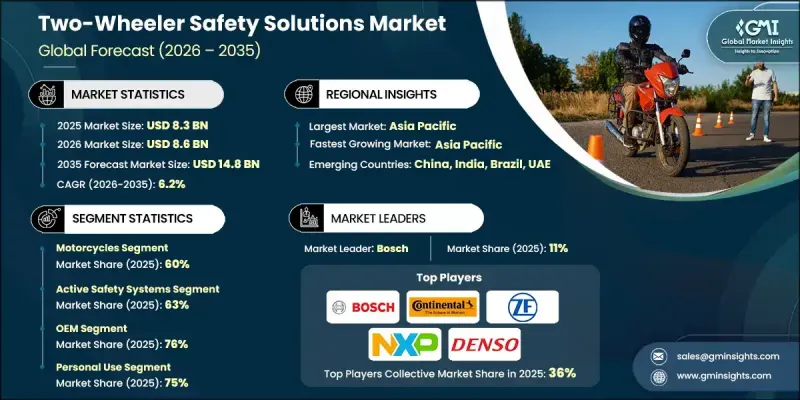
The Global Two-Wheeler Safety Solutions Market was valued at USD 8.3 billion in 2025 and is estimated to grow at a CAGR of 6.2% to reach USD 14.8 billion by 2035.
The market focuses on technologies designed to protect riders and minimize injury severity during road incidents. Safety solutions are structured around preventive systems that actively reduce accident probability and protective systems that mitigate physical harm when crashes occur. Continuous innovation in electronics, sensor technology, artificial intelligence, and vehicle connectivity has reshaped safety expectations across the two-wheeler ecosystem. Regulatory enforcement across key regions and growing rider awareness have accelerated adoption rates, while cost optimization has enabled safety integration beyond premium models. Manufacturers increasingly embed intelligent software-driven features to enhance situational awareness, vehicle stability, and rider responsiveness. Connectivity-enabled safety platforms support data-driven insights, improving accident response times and vehicle diagnostics. These developments collectively enhance rider confidence and support safer urban and highway mobility. The market's evolution reflects a shift from mechanical safety components to digitally enabled systems that support real-time decision-making and long-term performance monitoring, reinforcing the role of safety as a core value proposition in modern two-wheelers.
| Market Scope | |
|---|---|
| Start Year | 2025 |
| Forecast Year | 2026-2035 |
| Start Value | $8.3 Billion |
| Forecast Value | $14.8 Billion |
| CAGR | 6.2% |
Advanced rider assistance and electronically supported safety functions are increasingly embedded in high-end motorcycles and scooters, signaling stronger demand for intelligent safety integration. The use of connected safety platforms supported by IoT frameworks, satellite positioning, emergency response functions, crash sensing, and continuous rider analytics is accelerating. Integration with smartphones, high-speed connectivity, and cloud-based processing enables capabilities related to maintenance forecasting, safer route guidance, and coordinated emergency services, particularly in densely populated cities and fleet-based mobility operations.
The motorcycles segment accounted for 60% share in 2025 and is forecast to grow at a CAGR of 5.7% between 2026 and 2035. This category includes commuter models, touring motorcycles, performance-oriented bikes, adventure variants, and cruisers, each requiring tailored safety configurations. Market leadership is supported by a substantial global vehicle base, higher average selling prices that support advanced safety adoption, and stringent safety regulations driven by elevated speed capabilities and accident exposure.
The active safety systems segment held a 63% share in 2025 and is projected to register the fastest growth at a CAGR of 6.6% from 2026 to 2035. Strong regulatory backing, declining system costs due to technological maturity, and demonstrated effectiveness in accident reduction continue to drive adoption. Braking control technologies remain the most broadly deployed active safety solutions and are legally required in multiple major economies for motorcycles above defined engine thresholds.
China Two-Wheeler Safety Solutions Market is anticipated to grow at a CAGR of 6.6% during 2026 to 2035. China leads global electric two-wheeler adoption, with electric models accounting for more than 90% of new unit sales across several segments. This dominance supports demand for digitally advanced safety architectures. Policy support through clean mobility incentives, urban access advantages for electric vehicles, and the gradual rollout of safety-focused regulations continues to reshape market dynamics.
Key companies shaping the Global Two-Wheeler Safety Solutions Market include Bosch, Continental, ZF, Denso, Autoliv, Valeo, Harman, NXP, Delphi, and Magneti Marelli. Companies operating in the Two-Wheeler Safety Solutions Market focus on technology integration, strategic partnerships, and geographic expansion to strengthen market positioning. Leading players prioritize investment in software-defined safety platforms, sensor fusion, and data analytics to improve system intelligence and reliability. Collaboration with two-wheeler manufacturers enables early-stage integration of safety technologies into new vehicle platforms. Firms also emphasize scalable and cost-efficient solutions to penetrate mid-range and entry-level segments. Expansion in high-growth regions, particularly Asia-Pacific, supports volume growth and regulatory alignment.
Table of Contents
Chapter 1 Methodology
- 1.1 Research approach
- 1.2 Quality commitments
- 1.3 Research trail and confidence scoring
- 1.3.1 Research trail components
- 1.3.2 Scoring components
- 1.4 Data collection
- 1.4.1 Partial list of primary sources
- 1.5 Data mining sources
- 1.5.1 Paid sources
- 1.6 Best estimates and calculations
- 1.6.1 Base year calculation for any one approach
- 1.7 Forecast model
- 1.8 Research transparency addendum
Chapter 2 Executive Summary
- 2.1 Industry 360° synopsis, 2022 - 2035
- 2.2 Key market trends
- 2.2.1 Regional
- 2.2.2 Technology
- 2.2.3 Vehicle
- 2.2.4 Sales Channel
- 2.2.5 Application
- 2.3 TAM Analysis, 2026-2035
- 2.4 CXO perspectives: Strategic imperatives
- 2.4.1 Executive decision points
- 2.4.2 Critical success factors
- 2.5 Future outlook and strategic recommendations
Chapter 3 Industry Insights
- 3.1 Industry ecosystem analysis
- 3.1.1 Supplier landscape
- 3.1.2 Profit margin analysis
- 3.1.3 Cost structure
- 3.1.4 Value addition at each stage
- 3.1.5 Factor affecting the value chain
- 3.1.6 Disruptions
- 3.2 Industry impact forces
- 3.2.1.1 Growth drivers
- 3.2.1.2 Rising urbanization and increasing traffic congestion
- 3.2.1.3 Integration of AI, IoT, and sensors to develop advanced safety features
- 3.2.1.4 Stringent safety regulations
- 3.2.1.5 Growing awareness among consumers about rider safety
- 3.2.1.6 Increasing road accident rates & safety awareness
- 3.2.2 Industry pitfalls and challenges
- 3.2.2.1 High cost of advanced safety systems
- 3.2.2.2 Limited adoption in low-cost vehicles
- 3.2.3 Market opportunities
- 3.2.3.1 Smart and connected safety devices adoption
- 3.2.3.2 Aftermarket and retrofit solutions demand
- 3.2.3.3 Integration of safety tech in electric two-wheelers
- 3.2.3.4 Fleet and commercial safety solutions growth
- 3.3 Growth potential analysis
- 3.4 Regulatory landscape
- 3.4.1 North America
- 3.4.1.1 US- federal motor vehicle safety standards (FMVSS)
- 3.4.1.2 Canada - Motor vehicle safety regulations (MVSR)
- 3.4.2 Europe
- 3.4.2.1 Germany- EU Regulation 168/2013
- 3.4.2.2 UK- UK road vehicles (Construction and Use) regulations 1986
- 3.4.2.3 France- RE2020
- 3.4.2.4 Italy- PNRR road safety mandates
- 3.4.3 Asia Pacific
- 3.4.3.1 China- GB/T vehicle safety standards
- 3.4.3.2 India- Motor vehicles (Amendment) Act 2019
- 3.4.3.3 Japan- i-Construction and road traffic act
- 3.4.3.4 Australia- Australian design rules (ADR)
- 3.4.4 LATAM
- 3.4.4.1 Mexico- Official Mexican standard NOM-036-SCFI-2018
- 3.4.4.2 Argentina- National traffic law 24.449
- 3.4.5 MEA
- 3.4.5.1 South Africa- National road traffic act (1996)
- 3.4.5.2 Saudi Arabia- Traffic law & vision 2030 transport initiatives
- 3.4.1 North America
- 3.5 Porter';s analysis
- 3.6 PESTEL analysis
- 3.7 Technology and innovation landscape
- 3.7.1 Current technological trends
- 3.7.2 Emerging technologies
- 3.8 Patent analysis
- 3.9 Use cases & success stories
- 3.10 Sustainability and environmental aspects
- 3.10.1 Sustainable practices
- 3.10.2 Waste reduction strategies
- 3.10.3 Energy efficiency in production
- 3.10.4 Eco-friendly Initiatives
- 3.10.5 Carbon footprint considerations
- 3.11 Pricing, Commercial & Revenue Models
- 3.12 Hardware Investment vs Software / Subscription Economics
- 3.13 OEM Integration & Platform Adoption Economics
- 3.14 Total Cost of Ownership (TCO) for OEMs & Fleets
Chapter 4 Competitive Landscape, 2025
- 4.1 Introduction
- 4.2 Company market share analysis
- 4.2.1 North America
- 4.2.2 Europe
- 4.2.3 Asia Pacific
- 4.2.4 LATAM
- 4.2.5 MEA
- 4.3 Competitive analysis of major market players
- 4.4 Competitive positioning matrix
- 4.5 Strategic outlook matrix
- 4.6 Key developments
- 4.6.1 Mergers & acquisitions
- 4.6.2 Partnerships & collaborations
- 4.6.3 New product launches
- 4.6.4 Expansion plans and funding
Chapter 5 Market Estimates & Forecast, By Technology, 2022 - 2035 ($Bn, Units)
- 5.1 Key trends
- 5.2 Active safety systems
- 5.2.1 Anti-lock braking systems (ABS)
- 5.2.2 Traction control systems (TCS)
- 5.2.3 Adaptive cruise control (ACC)
- 5.2.4 Advanced rider assistance systems (ARAS)
- 5.3 Passive safety systems
- 5.3.1 Airbags
- 5.3.2 Smart helmets
- 5.3.3 Protective clothing
Chapter 6 Market Estimates & Forecast, By Vehicles, 2022 - 2035 ($Bn, Units)
- 6.1 Key trends
- 6.2 Motorcycles
- 6.3 Scooters
Chapter 7 Market Estimates & Forecast, By Sales Channel, 2022 - 2035 ($Bn, Units)
- 7.1 Key trends
- 7.2 OEM
- 7.3 Aftermarket
Chapter 8 Market Estimates & Forecast, By Application, 2022 - 2035 ($Bn, Units)
- 8.1 Key trends
- 8.2 Personal use
- 8.3 Commercial / fleet
Chapter 9 Market Estimates & Forecast, By Region, 2022 - 2035 ($Bn, Units)
- 9.1 Key trends
- 9.2 North America
- 9.2.1 US
- 9.2.2 Canada
- 9.3 Europe
- 9.3.1 Germany
- 9.3.2 UK
- 9.3.3 France
- 9.3.4 Italy
- 9.3.5 Spain
- 9.3.6 Russia
- 9.3.7 Nordics
- 9.3.8 Benelux
- 9.4 Asia Pacific
- 9.4.1 China
- 9.4.2 India
- 9.4.3 Japan
- 9.4.4 Australia
- 9.4.5 South Korea
- 9.4.6 Singapore
- 9.4.7 Thailand
- 9.4.8 Indonesia
- 9.4.9 Vietnam
- 9.5 Latin America
- 9.5.1 Brazil
- 9.5.2 Mexico
- 9.5.3 Argentina
- 9.5.4 Colombia
- 9.6 MEA
- 9.6.1 South Africa
- 9.6.2 Saudi Arabia
- 9.6.3 UAE
Chapter 10 Company Profiles
- 10.1 Global Players
- 10.1.1 Autoliv
- 10.1.2 BMW Motorrad
- 10.1.3 Bosch
- 10.1.4 Continental
- 10.1.5 Delphi
- 10.1.6 Denso
- 10.1.7 Harman
- 10.1.8 Honda
- 10.1.9 Kawasaki
- 10.1.10 Magneti Marelli
- 10.1.11 NXP
- 10.1.12 Valeo
- 10.1.13 Yamaha
- 10.1.14 ZF
- 10.2 Regional Players
- 10.2.1 Alpinestars
- 10.2.2 Dainese
- 10.2.3 Helite
- 10.2.4 Klim
- 10.2.5 Racer Gloves
- 10.2.6 Spidi
- 10.3 Emerging Technology Innovators
- 10.3.1 In&Motion
- 10.3.2 Leatt
- 10.3.3 Reevu
- 10.3.4 RST
- 10.3.5 Sena Technologies

