
PUBLISHER: Global Market Insights Inc. | PRODUCT CODE: 1913325

PUBLISHER: Global Market Insights Inc. | PRODUCT CODE: 1913325
Security Control Room Market Opportunity, Growth Drivers, Industry Trend Analysis, and Forecast 2026 - 2035
The Global Security Control Room Market was valued at USD 11.5 billion in 2025 and is estimated to grow at a CAGR of 6.2% to reach USD 20.8 billion by 2035.
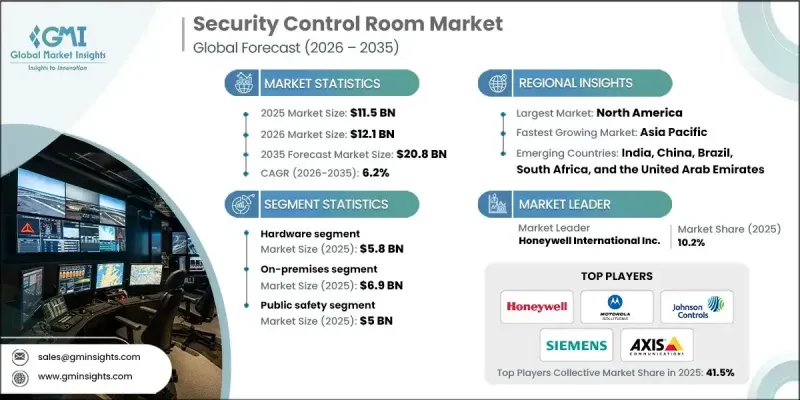
Market development is driven by accelerating urban expansion, rising investments in smart city initiatives, heightened focus on public safety and national security, and the continued build-out of critical infrastructure and transportation networks. Organizations across both public and private sectors are increasingly prioritizing centralized security operations to improve monitoring, coordination, and response capabilities. Security control rooms are evolving into highly integrated operational environments that support real-time decision-making and unified oversight. Growing reliance on advanced command and control platforms is improving situational awareness while enabling faster incident management and operational continuity. As cities, enterprises, and infrastructure operators pursue resilience and risk mitigation, demand for sophisticated control room environments continues to rise. This momentum is reinforced by modernization efforts aimed at improving reliability, interoperability, and operational efficiency across security ecosystems.
| Market Scope | |
|---|---|
| Start Year | 2025 |
| Forecast Year | 2026-2035 |
| Start Value | $11.5 Billion |
| Forecast Value | $20.8 Billion |
| CAGR | 6.2% |
Rapid urban development is driving governments to upgrade infrastructure to manage population density, mobility, and safety more effectively. Centralized command facilities are becoming integral to urban management strategies by consolidating monitoring, coordination, and emergency response capabilities into single operational environments. These facilities support real-time visibility and faster reaction during incidents, strengthening public sector demand for advanced control room investments. Governments are also expanding security capabilities to address evolving threats that require improved coordination and data-driven awareness. Control rooms are increasingly serving as central hubs for continuous monitoring and response through integrated data streams from surveillance and communication systems.
The hardware segment generated USD 5.8 billion in 2025. Demand is being supported by increased deployment of advanced visualization systems, sensors, and display technologies designed to deliver reliable, real-time monitoring. Infrastructure upgrades across public services, transportation, and essential facilities are further accelerating the adoption of hardware-intensive control room solutions.
The on-premises segment reached USD 6.9 billion in 2025. Strong demand from government bodies and operators of critical assets continues to support this segment, as localized data control and system reliability remain top priorities. Ongoing modernization of urban and transport infrastructure is driving on-premises deployments due to their performance consistency and low-latency operation.
North America Security Control Room Market accounted for 34.6% share in 2025. Regional growth is supported by integration of control rooms with emergency communication systems, real-time analytics platforms, and coordinated response frameworks across multiple administrative levels. Investment priorities focus on improving interoperability, operational visibility, and coordinated response capabilities.
Key companies operating in the Global Security Control Room Market include Honeywell International Inc, Siemens AG, Motorola Solutions, Axis Communications AB, Genetec Inc., ABB Ltd., Johnson Controls International, Barco NV, Hexagon AB, Securitas Technology, Eizo Corporation, Tyler Technologies, Convergint Technologies LLC, Hangzhou Hikvision Digital Technology Co., Ltd., Kastle Systems, Milestone Systems A/S, RGB Spectrum, ATEN INTERNATIONAL Co., Ltd., Buren Systems International BV, Access Hardware, Inc., and AxxonSoft. Companies in the Global Security Control Room Market are reinforcing their competitive position through continuous innovation and expansion of integrated solutions. Many providers are investing in advanced software platforms that enhance real-time analytics, system interoperability, and centralized command capabilities. Strategic partnerships with governments, infrastructure operators, and technology firms are helping expand market reach and accelerate deployment. Firms are also focusing on modular and scalable designs to support diverse operational requirements.
Table of Contents
Chapter 1 Methodology and Scope
- 1.1 Market scope and definition
- 1.2 Research design
- 1.2.1 Research approach
- 1.2.2 Data collection methods
- 1.3 Data mining sources
- 1.3.1 Global
- 1.3.2 Regional/Country
- 1.4 Base estimates and calculations
- 1.4.1 Base year calculation
- 1.4.2 Key trends for market estimation
- 1.5 Primary research and validation
- 1.5.1 Primary sources
- 1.6 Forecast model
- 1.7 Research assumptions and limitations
Chapter 2 Executive Summary
- 2.1 Industry 3600 synopsis
- 2.2 Key market trends
- 2.2.1 Offering trends
- 2.2.2 Deployment mode trends
- 2.2.3 Application trends
- 2.2.4 End use trends
- 2.2.5 Regional trends
- 2.3 TAM Analysis, 2026-2035 (USD Million)
- 2.4 CXO perspectives: Strategic imperatives
- 2.4.1 Executive decision points
- 2.4.2 Critical success factors
- 2.5 Future outlook and strategic recommendations
Chapter 3 Industry Insights
- 3.1 Industry ecosystem analysis
- 3.1.1 Supplier landscape
- 3.1.2 Profit margin
- 3.1.3 Cost structure
- 3.1.4 Value addition at each stage
- 3.1.5 Factor affecting the value chain
- 3.1.6 Disruptions
- 3.2 Industry impact forces
- 3.2.1 Growth drivers
- 3.2.1.1 Rising urbanization and smart city investments
- 3.2.1.2 Increasing public safety and homeland security concerns
- 3.2.1.3 Expansion of critical infrastructure and transportation networks
- 3.2.1.4 Growing adoption of integrated command and control systems
- 3.2.1.5 Rising corporate demand for centralized security operations
- 3.2.2 Pitfalls and challenges
- 3.2.2.1 High initial capital and system integration costs
- 3.2.2.2 Cybersecurity risks and data privacy concerns
- 3.2.1 Growth drivers
- 3.3 Growth potential analysis
- 3.4 Regulatory landscape
- 3.4.1 North America
- 3.4.2 Europe
- 3.4.3 Asia Pacific
- 3.4.4 Latin America
- 3.4.5 Middle East & Africa
- 3.5 Porter's analysis
- 3.6 PESTEL analysis
- 3.7 Technology and Innovation landscape
- 3.7.1 Current technological trends
- 3.7.2 Emerging technologies
- 3.8 Emerging Business Models
- 3.9 Compliance Requirements
- 3.10 Sustainability Initiatives
- 3.11 Supply Chain Resilience
- 3.12 Geopolitical Analysis
- 3.13 Digital Transformation
Chapter 4 Competitive Landscape, 2025
- 4.1 Introduction
- 4.2 Company market share analysis
- 4.2.1 By region
- 4.2.1.1 North America
- 4.2.1.2 Europe
- 4.2.1.3 Asia Pacific
- 4.2.1.4 Latin America
- 4.2.1.5 Middle East & Africa
- 4.2.2 Market concentration analysis
- 4.2.1 By region
- 4.3 Competitive benchmarking of key players
- 4.3.1 Product portfolio comparison
- 4.3.1.1 Product range breadth
- 4.3.1.2 Technology
- 4.3.1.3 Innovation
- 4.3.2 Geographic presence comparison
- 4.3.2.1 Global footprint analysis
- 4.3.2.2 Service network coverage
- 4.3.2.3 Market penetration by region
- 4.3.3 Competitive positioning matrix
- 4.3.3.1 Leaders
- 4.3.3.2 Challengers
- 4.3.3.3 Followers
- 4.3.3.4 Niche players
- 4.3.4 Strategic outlook matrix
- 4.3.1 Product portfolio comparison
- 4.4 Key developments, 2022-2025
- 4.4.1 Mergers and acquisitions
- 4.4.2 Partnerships and collaborations
- 4.4.3 Technological advancements
- 4.4.4 Expansion and investment strategies
- 4.4.5 Sustainability initiatives
- 4.4.6 Digital transformation initiatives
- 4.5 Emerging/ startup competitors landscape
Chapter 5 Market Estimates and Forecast, By Offering, 2022 - 2035 (USD Million)
- 5.1 Key trends
- 5.2 Hardware
- 5.2.1 Display systems
- 5.2.2 Projectors
- 5.2.3 KVM switches & control equipment
- 5.2.4 Operator workstations & consoles
- 5.2.5 Network infrastructure equipment
- 5.2.6 Servers & storage systems
- 5.2.7 Others
- 5.3 Software
- 5.3.1 Video Management Systems (VMS)
- 5.3.2 Physical Security Information Management (PSIM)
- 5.3.3 Access control management software
- 5.3.4 Analytics & AI/ML platforms
- 5.3.5 Incident management systems
- 5.3.6 Command & control platforms
- 5.3.7 Visualization & dashboard software
- 5.3.8 Others
- 5.4 Services
- 5.4.1 System integration & installation services
- 5.4.2 Maintenance & technical support
- 5.4.3 Consulting & design services
- 5.4.4 Training & operator development
- 5.4.5 Others
Chapter 6 Market Estimates and Forecast, By Deployment Mode, 2022 - 2035 (USD Million)
- 6.1 Key trends
- 6.2 On-premises
- 6.3 Cloud-based
- 6.4 Hybrid
Chapter 7 Market Estimates and Forecast, By Application, 2022 - 2035 (USD Million)
- 7.1 Key trends
- 7.2 Public safety
- 7.3 Corporate safety
- 7.4 Industrial safety
Chapter 8 Market Estimates and Forecast, By End Use, 2022 - 2035 (USD Million)
- 8.1 Key trends
- 8.2 Government & defense
- 8.2.1 Law enforcement & police operations
- 8.2.2 Military & defense
- 8.2.3 Border security & immigration control
- 8.2.4 Intelligence & national security agencies
- 8.2.5 Others
- 8.3 Transportation
- 8.3.1 Airports & aviation security
- 8.3.2 Seaports & maritime security
- 8.3.3 Railways & mass transit systems
- 8.3.4 Logistics & distribution centers
- 8.3.5 Others
- 8.4 BFSI
- 8.4.1 Bank branches & atm networks
- 8.4.2 Data centers
- 8.4.3 Others
- 8.5 Manufacturing
- 8.5.1 Automotive
- 8.5.2 Electronics & semiconductor
- 8.5.3 Aerospace & defense
- 8.5.4 Chemicals & petrochemicals
- 8.5.5 Food & beverage
- 8.5.6 Others
- 8.6 Utilities
- 8.6.1 Power generation & distribution
- 8.6.2 Water & wastewater treatment
- 8.6.3 Oil & gas infrastructure
- 8.6.4 Others
- 8.7 Healthcare
- 8.7.1 Hospitals & medical centers
- 8.7.2 Pharmaceutical manufacturing
- 8.7.3 Patient safety & access control
- 8.7.4 Others
- 8.8 Retail & commercial real estate
- 8.8.1 Shopping malls & retail chains
- 8.8.2 Corporate office buildings
- 8.8.3 Commercial complexes
- 8.8.4 Others
- 8.9 Others
Chapter 9 Market Estimates and Forecast, By Region, 2022 - 2035 (USD Million)
- 9.1 Key trends
- 9.2 North America
- 9.2.1 U.S.
- 9.2.2 Canada
- 9.3 Europe
- 9.3.1 Germany
- 9.3.2 UK
- 9.3.3 France
- 9.3.4 Spain
- 9.3.5 Italy
- 9.3.6 Netherlands
- 9.4 Asia Pacific
- 9.4.1 China
- 9.4.2 India
- 9.4.3 Japan
- 9.4.4 Australia
- 9.4.5 South Korea
- 9.5 Latin America
- 9.5.1 Brazil
- 9.5.2 Mexico
- 9.5.3 Argentina
- 9.6 Middle East and Africa
- 9.6.1 Saudi Arabia
- 9.6.2 South Africa
- 9.6.3 UAE
Chapter 10 Company Profiles
- 10.1 Global Key Players
- 10.1.1 ABB Ltd.
- 10.1.2 Honeywell International Inc
- 10.1.3 Siemens AG
- 10.1.4 Johnson Controls International
- 10.1.5 Motorola Solutions
- 10.2 Regional Key Players
- 10.2.1 North America
- 10.2.1.1 Convergint Technologies LLC
- 10.2.1.2 Genetec Inc.
- 10.2.1.3 Tyler Technologies
- 10.2.1.4 Kastle Systems
- 10.2.1.5 Access Hardware, Inc.
- 10.2.2 Europe
- 10.2.2.1 Axis Communications AB
- 10.2.2.2 Barco NV
- 10.2.2.3 Milestone Systems A/S
- 10.2.2.4 Hexagon AB
- 10.2.2.5 Buren Systems International BV
- 10.2.3 Asia Pacific
- 10.2.3.1 Hangzhou Hikvision Digital Technology Co., Ltd.
- 10.2.3.2 Eizo Corporation
- 10.2.3.3 ATEN INTERNATIONAL Co., Ltd.
- 10.2.1 North America
- 10.3 Niche / Disruptors
- 10.3.1 RGB Spectrum
- 10.3.2 Securitas Technology
- 10.3.3 AxxonSoft

