
PUBLISHER: Aviation & Defense Market Reports (A&D) | PRODUCT CODE: 1896744

PUBLISHER: Aviation & Defense Market Reports (A&D) | PRODUCT CODE: 1896744
Global Directed Energy Weapons Market 2026-2036
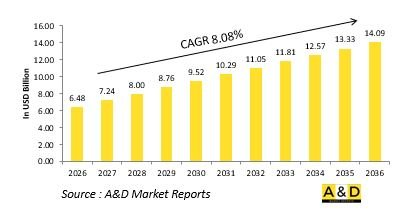
The Global Directed Energy Weapons market is estimated at USD 6.48 billion in 2026, projected to grow to USD 14.09 billion by 2036 at a Compound Annual Growth Rate (CAGR) of 8.08% over the forecast period 2026-2036.
Introduction to Directed Energy Weapons Market:
The defense directed energy weapons market represents a cutting-edge frontier in modern military technology, focusing on systems that use focused electromagnetic energy-such as lasers, microwaves, or particle beams-to disable, damage, or destroy targets with precision and speed. Unlike traditional kinetic weapons, directed energy weapons offer instantaneous engagement, reduced collateral damage, and low operational costs per use. These systems are being developed for applications across air, land, and naval platforms, including missile defense, anti-drone operations, and electronic disruption. As global defense forces seek enhanced accuracy, flexibility, and scalability in their arsenals, directed energy weapons are becoming increasingly attractive. They align with the growing need for agile, renewable, and non-kinetic solutions capable of addressing both conventional and asymmetric threats. Their emergence marks a transformative step toward energy-based warfare that complements existing deterrence and combat capabilities.
Technology Impact in Directed Energy Weapons Market:
Technological innovation is rapidly propelling the development and deployment of directed energy weapons. Advances in high-energy lasers, compact power sources, and beam control systems have significantly improved range, precision, and efficiency. Breakthroughs in thermal management and adaptive optics enable sustained operation without compromising accuracy. The integration of artificial intelligence and automated tracking enhances targeting and threat engagement in dynamic combat environments. Miniaturization of components has made directed energy systems more portable and adaptable to various platforms, from ground vehicles to aircraft and naval vessels. Additionally, improvements in energy storage and pulse generation have made these weapons more reliable for continuous use. The convergence of photonics, materials science, and digital control technologies has transformed directed energy systems from experimental prototypes into viable, deployable solutions, redefining the future of precision strike and defensive warfare capabilities.
Key Drivers in Directed Energy Weapons Market:
The increasing need for cost-effective, rapid-response solutions against evolving threats is a primary driver of the defense directed energy weapons market. Rising incidents of drone incursions, missile attacks, and swarming tactics have created demand for weapons capable of neutralizing multiple targets simultaneously. The ability of directed energy systems to engage threats at the speed of light, with minimal logistical burden, makes them highly attractive for defense modernization programs. Growing emphasis on precision warfare and reduced collateral damage further supports the transition toward non-kinetic, scalable weapon systems. Defense forces are also investing in directed energy technologies to counter high-speed projectiles and electronic threats that traditional systems struggle to intercept. Additionally, the shift toward multi-domain operations-integrating land, air, and maritime defense-drives the need for flexible, modular energy weapons that can operate seamlessly across platforms. These factors collectively reinforce the strategic importance of directed energy systems in next-generation defense planning.
Regional Trends in Directed Energy Weapons Market:
Regional developments in the defense directed energy weapons market reflect differing strategic priorities and technological capacities. North America continues to dominate the field, driven by sustained research, testing, and deployment of laser-based and microwave weapon systems across all defense branches. Europe is focusing on collaborative research programs aimed at integrating directed energy solutions into air defense and naval applications. The Asia-Pacific region is rapidly advancing its indigenous capabilities, emphasizing high-power laser and microwave systems for counter-drone and missile defense. In the Middle East, directed energy technologies are being explored to protect critical infrastructure and counter aerial threats in volatile environments. Latin America and Africa are gradually entering the domain through technology partnerships and defense collaborations. Across all regions, governments recognize the potential of directed energy weapons to redefine deterrence, offering precise, scalable, and energy-efficient responses to emerging battlefield challenges.
Key Directed Energy Weapons Program:
The Mk-II(A) Shahastra Shakti marked a major milestone in India's directed energy weapons programme in April 2026, following the successful test demonstration of the laser-based system. This indigenous 30 kW, vehicle-mounted platform developed by DRDO's CHESS division has demonstrated the ability to neutralise various aerial threats-including fixed-wing drones, swarm drones and surveillance sensors-at distances of up to 5 km. The Shahastra Shakti system incorporates six 5 kW laser beams and is equipped with advanced electronic warfare capabilities along with a 360-degree Electro-Optical/Infrared (EO/IR) sensor for accurate target engagement. Currently undergoing trials, it is expected to become operational within the next two years. DRDO is also progressing on next-generation variants with projected power levels between 50 and 100 kW, intended to counter more advanced threats such as cruise missiles, fighter aircraft and artillery rounds, thereby significantly enhancing India's directed energy weapons capabilities.
Table of Contents
Directed Energy Weapons Market - Table of Contents
Directed Energy Weapons Market Report Definition
Directed Energy Weapons Market Segmentation
By Region
By Technology
By Platform
Directed Energy Weapons Market Analysis for next 10 Years
The 10-year directed energy weapons market analysis would give a detailed overview of directed energy weapons market growth, changing dynamics, technology adoption overviews and the overall market attractiveness is covered in this chapter.
Market Technologies of Directed Energy Weapons Market
This segment covers the top 10 technologies that is expected to impact this market and the possible implications these technologies would have on the overall market.
Global Directed Energy Weapons Market Forecast
The 10-year directed energy weapons market forecast of this market is covered in detailed across the segments which are mentioned above.
Regional Directed Energy Weapons Market Trends & Forecast
The regional directed energy weapons market trends, drivers, restraints and Challenges of this market, the Political, Economic, Social and Technology aspects are covered in this segment. The market forecast and scenario analysis across regions are also covered in detailed in this segment. The last part of the regional analysis includes profiling of the key companies, supplier landscape and company benchmarking. The current market size is estimated based on the normal scenario.
North America
Drivers, Restraints and Challenges
PEST
Market Forecast & Scenario Analysis
Key Companies
Supplier Tier Landscape
Company Benchmarking
Europe
Middle East
APAC
South America
Country Analysis of Directed Energy Weapons Market
This chapter deals with the key defense programs in this market, it also covers the latest news and patents which have been filed in this market. Country level 10 year market forecast and scenario analysis are also covered in this chapter.
US
Defense Programs
Latest News
Patents
Current levels of technology maturation in this market
Market Forecast & Scenario Analysis
Canada
Italy
France
Germany
Netherlands
Belgium
Spain
Sweden
Greece
Australia
South Africa
India
China
Russia
South Korea
Japan
Malaysia
Singapore
Brazil
Opportunity Matrix for Directed Energy Weapons Market
The opportunity matrix helps the readers understand the high opportunity segments in this market.
Expert Opinions on Directed Energy Weapons Market Report
Hear from our experts their opinion of the possible analysis for this market.
Conclusions
About Aviation and Defense Market Reports
List of Tables
- Table 1: 10 Year Market Outlook, 2025-2035
- Table 2: Drivers, Impact Analysis, North America
- Table 3: Restraints, Impact Analysis, North America
- Table 4: Challenges, Impact Analysis, North America
- Table 5: Drivers, Impact Analysis, Europe
- Table 6: Restraints, Impact Analysis, Europe
- Table 7: Challenges, Impact Analysis, Europe
- Table 8: Drivers, Impact Analysis, Middle East
- Table 9: Restraints, Impact Analysis, Middle East
- Table 10: Challenges, Impact Analysis, Middle East
- Table 11: Drivers, Impact Analysis, APAC
- Table 12: Restraints, Impact Analysis, APAC
- Table 13: Challenges, Impact Analysis, APAC
- Table 14: Drivers, Impact Analysis, South America
- Table 15: Restraints, Impact Analysis, South America
- Table 16: Challenges, Impact Analysis, South America
- Table 17: Scenario Analysis, Scenario 1, By Region, 2025-2035
- Table 18: Scenario Analysis, Scenario 1, By Range, 2025-2035
- Table 19: Scenario Analysis, Scenario 1, By Type, 2025-2035
- Table 20: Scenario Analysis, Scenario 2, By Region, 2025-2035
- Table 21: Scenario Analysis, Scenario 2, By Range, 2025-2035
- Table 22: Scenario Analysis, Scenario 2, By Type, 2025-2035
List of Figures
- Figure 1: Global Defense Directed Energy Weapons Forecast, 2025-2035
- Figure 2: Global Defense Directed Energy Weapons Forecast, By Region, 2025-2035
- Figure 3: Global Defense Directed Energy Weapons Forecast, By Range, 2025-2035
- Figure 4: Global Defense Directed Energy Weapons Forecast, By Type, 2025-2035
- Figure 5: North America, Defense Directed Energy Weapons, Market Forecast, 2025-2035
- Figure 6: Europe, Defense Directed Energy Weapons, Market Forecast, 2025-2035
- Figure 7: Middle East, Defense Directed Energy Weapons, Market Forecast, 2025-2035
- Figure 8: APAC, Defense Directed Energy Weapons, Market Forecast, 2025-2035
- Figure 9: South America, Defense Directed Energy Weapons, Market Forecast, 2025-2035
- Figure 10: United States, Defense Directed Energy Weapons, Technology Maturation, 2025-2035
- Figure 11: United States, Defense Directed Energy Weapons, Market Forecast, 2025-2035
- Figure 12: Canada, Defense Directed Energy Weapons, Technology Maturation, 2025-2035
- Figure 13: Canada, Defense Directed Energy Weapons, Market Forecast, 2025-2035
- Figure 14: Italy, Defense Directed Energy Weapons, Technology Maturation, 2025-2035
- Figure 15: Italy, Defense Directed Energy Weapons, Market Forecast, 2025-2035
- Figure 16: France, Defense Directed Energy Weapons, Technology Maturation, 2025-2035
- Figure 17: France, Defense Directed Energy Weapons, Market Forecast, 2025-2035
- Figure 18: Germany, Defense Directed Energy Weapons, Technology Maturation, 2025-2035
- Figure 19: Germany, Defense Directed Energy Weapons, Market Forecast, 2025-2035
- Figure 20: Netherlands, Defense Directed Energy Weapons, Technology Maturation, 2025-2035
- Figure 21: Netherlands, Defense Directed Energy Weapons, Market Forecast, 2025-2035
- Figure 22: Belgium, Defense Directed Energy Weapons, Technology Maturation, 2025-2035
- Figure 23: Belgium, Defense Directed Energy Weapons, Market Forecast, 2025-2035
- Figure 24: Spain, Defense Directed Energy Weapons, Technology Maturation, 2025-2035
- Figure 25: Spain, Defense Directed Energy Weapons, Market Forecast, 2025-2035
- Figure 26: Sweden, Defense Directed Energy Weapons, Technology Maturation, 2025-2035
- Figure 27: Sweden, Defense Directed Energy Weapons, Market Forecast, 2025-2035
- Figure 28: Brazil, Defense Directed Energy Weapons, Technology Maturation, 2025-2035
- Figure 29: Brazil, Defense Directed Energy Weapons, Market Forecast, 2025-2035
- Figure 30: Australia, Defense Directed Energy Weapons, Technology Maturation, 2025-2035
- Figure 31: Australia, Defense Directed Energy Weapons, Market Forecast, 2025-2035
- Figure 32: India, Defense Directed Energy Weapons, Technology Maturation, 2025-2035
- Figure 33: India, Defense Directed Energy Weapons, Market Forecast, 2025-2035
- Figure 34: China, Defense Directed Energy Weapons, Technology Maturation, 2025-2035
- Figure 35: China, Defense Directed Energy Weapons, Market Forecast, 2025-2035
- Figure 36: Saudi Arabia, Defense Directed Energy Weapons, Technology Maturation, 2025-2035
- Figure 37: Saudi Arabia, Defense Directed Energy Weapons, Market Forecast, 2025-2035
- Figure 38: South Korea, Defense Directed Energy Weapons, Technology Maturation, 2025-2035
- Figure 39: South Korea, Defense Directed Energy Weapons, Market Forecast, 2025-2035
- Figure 40: Japan, Defense Directed Energy Weapons, Technology Maturation, 2025-2035
- Figure 41: Japan, Defense Directed Energy Weapons, Market Forecast, 2025-2035
- Figure 42: Malaysia, Defense Directed Energy Weapons, Technology Maturation, 2025-2035
- Figure 43: Malaysia, Defense Directed Energy Weapons, Market Forecast, 2025-2035
- Figure 44: Singapore, Defense Directed Energy Weapons, Technology Maturation, 2025-2035
- Figure 45: Singapore, Defense Directed Energy Weapons, Market Forecast, 2025-2035
- Figure 46: United Kingdom, Defense Directed Energy Weapons, Technology Maturation, 2025-2035
- Figure 47: United Kingdom, Defense Directed Energy Weapons, Market Forecast, 2025-2035
- Figure 48: Opportunity Analysis, Defense Directed Energy Weapons, By Region (Cumulative Market), 2025-2035
- Figure 49: Opportunity Analysis, Defense Directed Energy Weapons, By Region (CAGR), 2025-2035
- Figure 50: Opportunity Analysis, Defense Directed Energy Weapons, By Range (Cumulative Market), 2025-2035
- Figure 51: Opportunity Analysis, Defense Directed Energy Weapons, By Range (CAGR), 2025-2035
- Figure 52: Opportunity Analysis, Defense Directed Energy Weapons, By Type (Cumulative Market), 2025-2035
- Figure 53: Opportunity Analysis, Defense Directed Energy Weapons, By Type (CAGR), 2025-2035
- Figure 54: Scenario Analysis, Defense Directed Energy Weapons, Cumulative Market, 2025-2035
- Figure 55: Scenario Analysis, Defense Directed Energy Weapons, Global Market, 2025-2035
- Figure 56: Scenario 1, Defense Directed Energy Weapons, Total Market, 2025-2035
- Figure 57: Scenario 1, Defense Directed Energy Weapons, By Region, 2025-2035
- Figure 58: Scenario 1, Defense Directed Energy Weapons, By Range, 2025-2035
- Figure 59: Scenario 1, Defense Directed Energy Weapons, By Type, 2025-2035
- Figure 60: Scenario 2, Defense Directed Energy Weapons, Total Market, 2025-2035
- Figure 61: Scenario 2, Defense Directed Energy Weapons, By Region, 2025-2035
- Figure 62: Scenario 2, Defense Directed Energy Weapons, By Range, 2025-2035
- Figure 63: Scenario 2, Defense Directed Energy Weapons, By Type, 2025-2035
- Figure 64: Company Benchmark, Defense Directed Energy Weapons, 2025-2035

